
Hydrogen service hoses operate in an environment where pressure, gas permeability, electrical behaviour, and mechanical durability intersect. Ground hoses at refuelling stations may be repeatedly connected and moved, while fuel-cell systems require compact connections capable of handling hydrogen under demanding operating conditions.
These applications give reinforced hose extrusion line design a different set of priorities from conventional automotive fluid-tube production. DEKUMA’s extrusion technology provides a useful manufacturing reference, while the key engineering considerations lie in how hydrogen-service hose construction responds to its operating environment.
Material Selection for Hydrogen Service
Hydrogen molecules are exceptionally small, which makes permeation an important consideration when selecting hose materials. A polymer that performs adequately with water, coolant, or compressed air may behave differently when exposed to hydrogen over extended periods. The inner layer must consequently be selected according to pressure, temperature, hydrogen compatibility, and the acceptable permeation level of the intended application.
Multilayer construction can separate these responsibilities among different materials. One layer may provide the primary fluid barrier, while another contributes flexibility or mechanical protection. Reinforcement then supports the hose structure under pressure without requiring the barrier material itself to carry the entire mechanical load.
Chemical exposure is only one part of material durability. Refuelling-station hoses can encounter ultraviolet radiation, moisture, temperature variation, cleaning chemicals, and repeated mechanical handling. Fuel-cell connection hoses may instead spend most of their service life inside a protected vehicle compartment. The surrounding environment should consequently influence the outer-layer material and reinforcement design as much as the hydrogen medium influences the inner layer.
Reinforcement and Pressure Management
Hydrogen infrastructure can involve significantly higher pressures than many conventional automotive fluid circuits. Pressure rating must be considered together with hose diameter, wall construction, temperature, and cyclic loading rather than treated as an isolated numerical value. Repeated pressurisation and depressurisation can gradually expose weaknesses within the hose structure.
Reinforcement provides a means of controlling expansion under internal pressure. Fibre type, orientation, density, and placement all influence the resulting mechanical behaviour. Polyester and aramid, for example, offer different combinations of tensile strength, flexibility, weight, and thermal performance, allowing the reinforcement architecture to be matched to the intended service conditions.
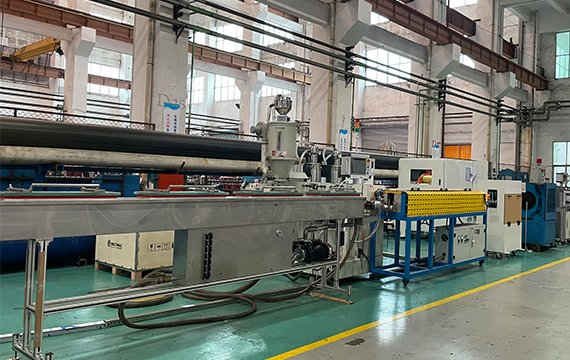
Production equipment must maintain consistent relationships among the inner liner, reinforcement, and outer covering. DEKUMA‘s TPV Knitted Reinforced Hose Extrusion Line uses a three-layer arrangement consisting of a TPV inner layer, knitted polyester or aramid reinforcement, and TPV outer coating. The system also supports double-layer and single-layer hose configurations, illustrating how multilayer extrusion can be adapted to different construction requirements without making the equipment itself the focus of the application.
Static Dissipation and Hydrogen Safety
Electrical behaviour becomes particularly relevant around hydrogen handling equipment. Static charge can accumulate when gases move through polymeric components, especially where flow rates, surface characteristics, and environmental conditions create opportunities for charge generation. Hose construction may consequently need to incorporate conductive or dissipative features appropriate to the system design.
Static dissipation should not be confused with ordinary electrical conductivity. The objective in many applications is controlled charge release rather than unrestricted current flow. Material formulation, reinforcement, grounding arrangements, and hose-system interfaces can all influence the final electrical characteristics.
Testing methods also need to reflect the intended application. Electrical resistance measurements may form one part of qualification, while pressure cycling, burst testing, leakage checks, permeation evaluation, and dimensional inspection address other performance requirements. A hose intended for a refuelling station may also require repeated bending and connection cycles that would be less representative of a permanently installed fuel-cell line.
Production Differences from Automotive Fluid Hose
Standard automotive fluid hoses often transport coolant, air, fuel, or other liquids whose material requirements are well established. Hydrogen service draws additional attention to molecular permeation, pressure cycling, static behaviour, and gas-tight connections. The manufacturing process must accommodate these requirements from material feeding through multilayer formation and final inspection.
A TPV extruder may be relevant where thermoplastic vulcanizate formulations are selected for a particular hose structure, although material choice remains application-specific. Stable melt conditions influence layer thickness and surface quality, while synchronized processing becomes important when reinforcement is introduced between polymer layers. Excessive variation can affect both dimensional consistency and the relationship between the barrier and reinforcing structures.
Quality control should follow the actual failure modes expected in service. Dimensional checks alone cannot reveal every potential weakness in hydrogen hose construction. Pressure cycling, gas permeation, burst resistance, flexibility, electrical characteristics, and ageing behaviour may all require separate evaluation depending on the specification and applicable standard.
Conclusion
Hydrogen hose production demands a broader view of what constitutes a suitable fluid connection. The inner material must address hydrogen exposure, reinforcement must accommodate pressure and cyclic loads, and the overall construction may need controlled electrical behaviour alongside mechanical durability.
These requirements distinguish hydrogen service hose from many conventional automotive applications. DEKUMA’s TPV-based multilayer approach demonstrates one possible extrusion configuration, while a reinforced hose extrusion line and TPV extruder must ultimately be selected around the pressure, material, testing, and service conditions defined by each hydrogen infrastructure application.