

Meeting rooms often need furniture that can support daily work and adapt to changing layouts. Government offices, schools, healthcare facilities, and commercial organizations may use the same room for presentations, training, and group discussions. Table materials affect how easily staff can rearrange furniture, how well surfaces withstand regular use, and how much maintenance is required.
Choosing a flip top conference table involves more than comparing tabletop thickness or frame weight. Buyers should assess the surface, supporting structure, folding hardware, and floor-contact components as one system. The aim is to balance durability with manageable handling while keeping the table suitable for its intended environment.
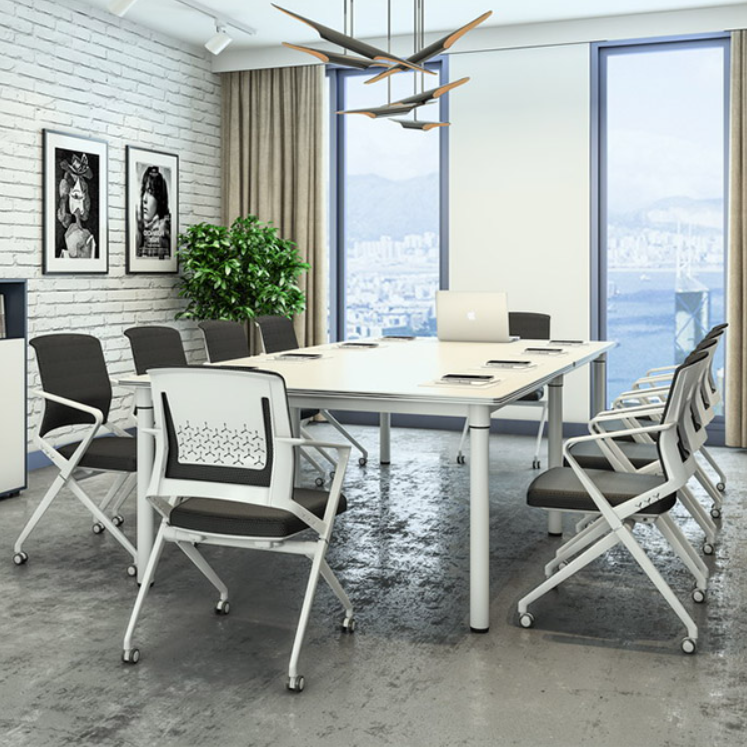
Which Tabletop Materials Suit Frequent Use?
Particle board with a melamine finish is a practical option for many indoor meeting rooms. The board provides a consistent working surface, while the finish supports routine cleaning and helps resist everyday surface wear. Its suitability depends on panel quality, edge treatment, and how well the table is protected from moisture.
Panel thickness affects both rigidity and overall weight. Thicker boards can provide a more substantial feel, but they also increase the load that staff must move when rearranging furniture. Buyers should compare thickness with the tabletop’s dimensions and supporting frame instead of treating thickness alone as a measure of quality.
High-pressure laminate over an appropriate substrate is another option for projects with demanding surface requirements. Its suitability depends on the substrate, bonding quality, and edge construction. Procurement teams should compare samples for scratch resistance, cleaning compatibility, and appearance under the lighting conditions of the actual room.
Steel or Aluminum: How Should Buyers Decide?
Steel is commonly used for beams and structural supports because it offers rigidity. Cold-rolled steel can provide a stable framework when the section dimensions, joints, and connections match the intended load. However, a heavier frame may require more effort during relocation, particularly when facilities staff handle several tables in one session.
Aluminum offers a useful alternative for selected structural components because it generally weighs less than steel of comparable volume. Its actual performance depends on the alloy, section design, wall thickness, and connection method. Buyers should review the complete frame rather than assume that aluminum automatically produces a lighter or more stable table.
Combining metals can balance these considerations. Aluminum columns and steel beams, for example, assign different materials to components with different structural roles. Finish quality also matters because exposed metal can be affected by scratches, cleaning chemicals, and wear around joints. Specifications should identify the finish used on each component.
Why Does the Folding Mechanism Matter?
Material selection cannot compensate for a poorly designed folding system. Hinges, release controls, locking points, and frame connections experience repeated movement during setup and storage. Buyers should ask how the mechanism locks in the working position and what prevents accidental release while the table is being used.
The folding action should suit the people responsible for room preparation. Staff need sufficient clearance to operate the mechanism without trapping fingers or striking nearby furniture. Testing a sample helps reveal whether the tabletop moves smoothly and whether the folded unit can be handled safely.
Storage requirements also influence the design. Procurement teams should check the folded dimensions, stacking or nesting method, and space needed to move tables through doorways. The complete unit’s weight matters more than the weight of an individual panel or frame component. These checks help determine whether the design suits the site’s daily operating routine.
How Can Buyers Verify Material Specifications?
Before approving a bulk order, buyers should request a specification sheet covering tabletop composition, panel thickness, frame materials, component dimensions, finishes, and glide materials. Drawings can help confirm how the support structure connects to the top. Sample inspection should include surface edges, joints, fasteners, and the stability of the assembled table.
Environmental conditions deserve attention as well. E0-grade particle board is a useful specification to review when low-emission materials are required, but buyers should request supporting documentation relevant to the applicable project standards. Cleaning instructions should identify suitable products and explain how to prevent moisture from entering exposed edges or joints.
Procurement teams comparing a flip top conference table should also ask about replacement hinges, locking parts, and glides. Accessible spare parts can simplify maintenance and reduce the need to replace complete units after a small component wears out. Warranty coverage, service response arrangements, and delivery schedules should be confirmed in writing before the contract is finalized.
What Can Existing Table Designs Teach Buyers?
The HARRIS LS-418ST Fixed-top Meeting Table provides a useful reference for understanding how different materials serve different functions. Its tabletop uses 25 mm-thick E0-grade particle board with a durable melamine finish. This specification illustrates how panel thickness, surface treatment, and emission classification can be considered together when evaluating indoor furniture.
The model uses a 1.8 mm-thick aluminum column with a baking-varnish finish. Its beam is made from 50 × 25 × 1.5 mm cold-rolled steel, and its glides are polypropylene. White is the standard metal powder coating color, while silver and black are optional. These details offer a concrete basis for comparing material choices, although a fixed-top model does not verify folding performance.
Manufacturing capabilities can also matter when a project requires consistent furniture across several locations. Leadcom seating provides furniture production processes that include metal processing, spraying, injection molding, and wood processing. Its website states that Leadcom products are covered by a five-year manufacturer’s limited warranty against manufacturing defects under normal usage, together with lifetime maintenance. Buyers should confirm the precise product coverage, applicable terms, and support arrangements for their project.
Build the Final Specification Around Real Use
The appropriate material combination depends on how often tables move, how much storage space is available, and what loads the furniture must support. Melamine-faced particle board can provide a practical indoor surface, while steel and aluminum can serve complementary structural roles. Reliable folding hardware and suitable glides remain essential parts of the complete design.
Before placing an order, project teams should compare documented specifications, inspect a sample, and test the folding and storage process. Leadcom seating can be included in supplier evaluations alongside other manufacturers using the same criteria for materials, maintenance, warranty terms, and delivery requirements. This approach helps buyers select meeting furniture according to measurable needs rather than relying on material names or promotional descriptions alone.