


If you live in the UK, you don’t need a climatologist to tell you it’s been wet. The difference today is not just that it rains often, but that the pattern of rainfall is shifting: longer “unsettled” spells, heavier bursts, and winters that increasingly feel like a continuous soak rather than a season of intermittent showers. That matters because, in a country where so much housing stock is sensitive to moisture change and so much infrastructure sits on variable ground, persistent rain is not just a nuisance—it is a structural input.
A wetter baseline, plus heavier downpours
Recent Met Office reporting shows the UK has been running wetter-than-average, with 2024 recorded at 107% of average rainfall and notable regional extremes across parts of England.
Looking at the broader signal, the Met Office’s climate summaries highlight that the winter half-year (Oct–Mar) has become markedly wetter, with Oct 2023–Mar 2024 standing out as the wettest winter half-year on record for England and Wales (based on long-running rainfall series).
The physics is straightforward: warmer air holds more moisture, and when the atmosphere “unloads,” rainfall intensity rises. The Met Office notes that days of intense/prolonged rainfall are likely to increase with warming, and provides indicative projections for heavy rainfall days in England and Wales under different warming levels.
At the global assessment level, the IPCC also reports increasing heavy precipitation risk with warming in regions that include northern Europe.
When rain becomes a ground problem
Persistent rainfall does two things to the ground:
- It changes moisture regimes over time (slow saturation, elevated groundwater, softened near-surface strata).
- It drives fast hydraulic processes (runoff, piping/erosion, fines migration, void formation) when water finds pathways—joints, cracks, service trenches, poorly sealed interfaces.
In practice, you see the consequences as:
- localised soft spots and loss of bearing in pavements,
- voids beneath slabs and external hardstanding,
- differential settlement around drainage runs and utility corridors,
- and, in certain shrink–swell clays, cyclical movement that becomes more damaging when wet periods are prolonged and drying phases become sharper.
This is why the conversation about “constant rain” quickly becomes a conversation about maintenance, resilience, and diagnostics, not just umbrellas.
The built environment is feeling it: pluvial flooding and planning pressure
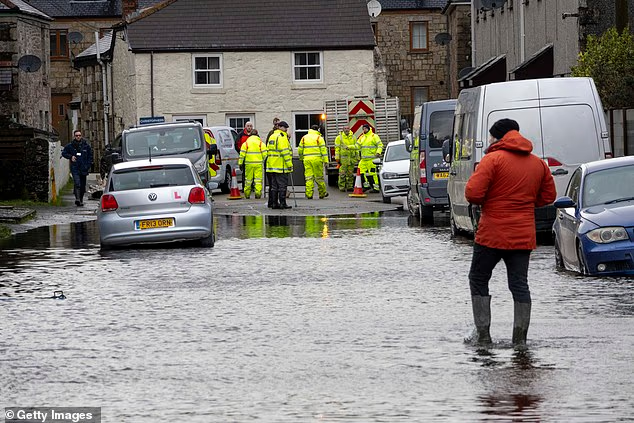
One of the most direct symptoms is surface water (pluvial) flooding—the kind that happens when intense rainfall overwhelms drainage capacity. The UK government’s guidance on the Risk of Flooding from Surface Water maps is explicitly aimed at helping interpret this risk and how it is represented.
Alongside that, national policy has long required that flood risk assessments incorporate climate change allowances for rainfall intensity and other drivers, precisely because design baselines are shifting.
And the pressure is not theoretical: reporting in February 2026 highlighted the increasing share of new homes being built in flood-risk areas in England, intensifying the importance of resilience measures and drainage strategy.
Roads, slabs, and “hidden” deterioration: water gets in, support gets lost
In pavements and slabs, the most damaging part is often invisible: the progressive loss of uniform support below the surface. Water enters through cracks, joints, or edges; it mobilises fines; it creates voids; and then traffic loads turn that hidden weakness into deformation.
This mechanism is described very clearly in GEOSEC’s technical writing on pavements and industrial slabs: once water gains access through cracks/joints, it can cause washouts and settlements in the supporting ground, reducing contact and triggering progressive deterioration.
A related GEOSEC article on roadways and streets frames the same idea at network scale—highlighting how climatic events can accelerate deterioration and how ground improvement beneath pavements can restore performance with minimal disruption.
So what should engineers and asset owners do differently?
The practical shift is to treat rainfall not as an occasional load case, but as an operating condition:
- Diagnose before you repair. Map where water is entering, where it is being retained, and where the ground is losing competence (surface water pathways, drainage defects, service corridors).
- Separate “surface defects” from “support defects.” A crack can be a symptom; the cause may be loss of support beneath.
- Prioritise drainage and interfaces. Edges, joints, thresholds, and transitions are where water wins first.
- Apply solutions that match the failure mechanism. In some cases, renewal is justified; in others, targeted ground improvement techniques such as resin injection for subsidence beneath slabs and pavements can re-establish support quickly, fill voids, and avoid long closures—especially where disruption costs dominate.
Closing thought
The UK will always be a rainy country. What is changing is the persistence and intensity of rainfall episodes, and therefore the frequency with which water moves from being “weather” to being an engineering driver. If we respond with better diagnostics, smarter drainage, and interventions that rebuild support where it has been lost, we don’t just repair damage—we make the next wet season less expensive.